

Sustainability


Environmental Management System
The Oenon Group’s two factories (Kurume and Yuzawa) have obtained certification under ISO 14001 the international standard for environmental management systems. We contribute toward the realization of a sustainable society by reducing environmental impact and through environmental preservation activities.
Environmental Initiatives
Energy Conservation Initiatives
The Oenon Group has been pursuing initiatives aimed at reducing greenhouse gas emissions by 46% by fiscal 2030 compared with fiscal 2013 levels. In fiscal 2024, we achieved a 51% reduction in greenhouse gas emissions.
Reducing CO2 Emissions by Introducing an Autonomous Heat Generation System
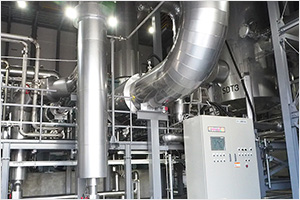
In 2019, we boosted capacity at the alcohol distillation facility of our Shimizu Factory. When doing so, we introduced an autonomous heat generation system that depressurizes the waste hot water generated during alcohol distillation, compresses it with a compressor, and reuses it as heat. As a result, this equipment achieves a 40% decrease in energy costs and a 35% annual reduction in CO2 emissions compared with the factory’s existing distillation equipment.
As a result, we reduced CO2 emissions by around 68,000 tons between October 2019 and December 2024.
Upgrade to Our Distillery Effluent Concentrator, Reduction of Industrial Waste, Fuel Use
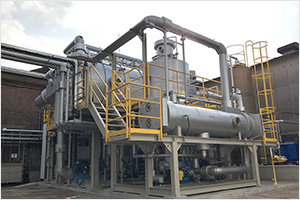
At our Kurume Factory, waste liquid from the distillation of shochu is concentrated in a distillery effluent concentrator. Some of the result is used in animal feed or as fuel for biomass generation.
We upgraded this equipment in 2018, raising its concentration efficiency by 7%, allowing the waste liquid from shochu distillation to be reduced in volume even further. In addition, the updated equipment compresses, raises the temperature of, and circulates the internally generated steam to reduce fuel consumption significantly.
Between January 2018 and December 2024, the crude oil equivalent amount of fuel used fell by around 3,360 kiloliters, and CO2 emissions were down by approximately 9,100 tons.
Reducing CO2 Emissions through the Installation of Shochu Lees Drying Equipment at the Kurume Factory
At the Kurume Factory, a shochu residue drying system has been installed and is now operational. This system enables more efficient on-site processing of distillation by-products, significantly reducing the weight of distillation residue sold as feed or fertilizer—by approximately 6.5% compared to the previous year in 2024—and thereby contributing to a reduction in CO2 emissions during transportation.
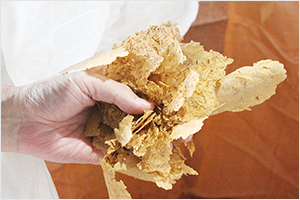
▲ dried shochu lees
Reduction in CO2 Emissions due to Factory Boiler Equipment Upgrades
At each of the Group's factories, we are sequentially replacing boilers with more environmentally friendly and efficient models, in the aim of reducing CO2 emissions. Our initiatives at individual factories are described below.
At the Kurume Factory, in 2020 we switched form the use of fuel oil to more environmentally friendly liquified natural gas, and brought and began running a gas boiler with boiler efficiency of 102%. Due to the boiler upgrade and fuel conversion, we reduced annual CO2 emissions in 2024 by 4,148 tons, outpacing our annual reduction target of 3,000 tons. The upgrade also addressed the heat situation, improving the working environment.
The Nirasaki Factory upgraded its fuel oil boilers in 2020, resulting in a 2% improvement in boiler efficiency and an annual CO2 reduction of 46 tons in 2024.
In 2021, the Asahikawa Factory (Taisetsu no Kura) upgraded to a gas boiler with higher operating efficiency. This upgrade reduced annual CO2 emissions by 300 tons in 2024.
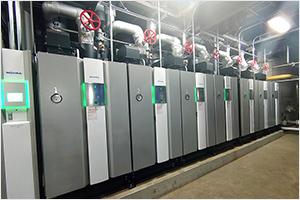
▲ Gas boiler at the Kurume Factory
Reduction of CO2 Emissions through Installing a Solar Power Generation System
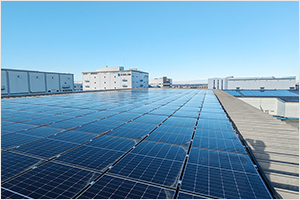
At the Nirasaki and Shimizu factories, the installation of solar power generation systems resulted in a reduction of approximately 102 tons of CO2 emissions in 2024.
Reducing CO2 Emissions through the Introduction of Green Energy
At the Asahikawa ,Tomakomai, Enzymes and Pharmaceuticals,Tokyo, Nirasaki, and Kurume Factory, we have introduced green electricity, which comes from natural energy generated without the production of CO2. This environmentally friendly power source is free from concerns about depletion of natural resources. As a result, the Company reduced annual CO2 emissions in 2024 by approximately 7,792 tons. We plan to introduce green energy at all our plants by 2026.
Industry-First Initiative(*1) to Transition to PET Bottles Made Using Recycled Materials
In 2021, we shifted the use of PET bottles (*2) for shochu and other spirits produced at the Tokyo, Asahikawa, Kurume, and Yuzawa factories to containers with 20% of materials recycled using the chemical recycling method (*3).
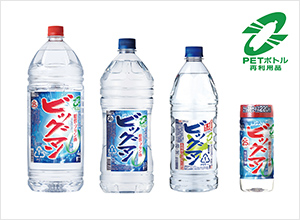
Furthermore, from April 2022 we have been gradually switching to containers that use 30% recycled materials instead of 20%. Compared to PET bottles made entirely from virgin material, this shift enables a reduction in CO2 emissions during production. In 2024, this initiative resulted in approximately 565 tons less CO2 emissions.
- ※1. This is the first instance in the alcoholic beverage industry of PET bottles for shochu products being made of materials recycled using the chemical recycling method.
- ※2. 200ml, 220ml, 1,800ml, 2,700ml, 4,000ml
- ※3. This is a recycling method in which used PET bottles that have been collected are broken down and refined into raw or intermediate materials for PET resin, which are then polymerized to make new PET resin. The PET resin can be recycled to the same high quality as virgin resin and can be recycled repeatedly.
CO2 Reduction through Modal Shift
For contract-manufactured products produced at AKITAKENHAKKO KOGYO on behalf of Group companies, the Company transitioned its transportation method from truck to rail freight in 2020 for deliveries from Akita Prefecture to the northern Tohoku and Kansai regions.
As a result of this modal shift, the Company achieved a reduction of approximately 182 tons in annual CO₂ emissions in 2024 compared to conventional truck transportation.
Switching out Company Cars for Hybrids and Other Eco-Friendly Vehicles
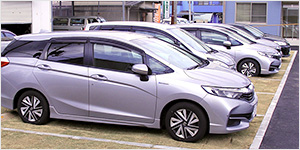
When lease agreements on Company cars come up for renewal, we are gradually switching out gasoline-powered vehicles in favor of hybrids, fuel-efficient mini cars, and other types of eco-friendly vehicles, as usage needs dictate.
As of December 2024, eco-friendly vehicles accounted for around 94% of our fleet.
Conversion and Management of CFC-Using Equipment
For air conditioning and refrigeration equipment that use chlorofluorocarbons (CFCs), we are gradually switching to CFC alternatives that have lower ozone depletion potential. In the future, we will consider introducing environmentally friendly equipment, with the goal of becoming CFC-free.
In addition, we have created a control ledger for equipment current equipment that uses CFCs. We are also tightening management to prevent CFC gases from leaking. Thorough management includes simple periodic inspections.
Environmental Protection Initiatives
Wastewater Treatment Initiatives
At each of our factories, we strive to prevent water pollution by installing wastewater treatment facilities that clean wastewater and return it to nature.
At our Tokyo Factory, we have added a pretreatment facility for wastewater treatment to reduce odor and improve wastewater purification capacity. Going forward, we will continue to promote the internal processing of waste and strive to reduce environmental impact.
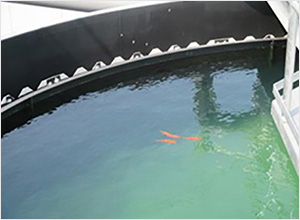
▲ Fish living and healthy in a tank of clean, purified water
Circulation and Reuse of Cooling Water
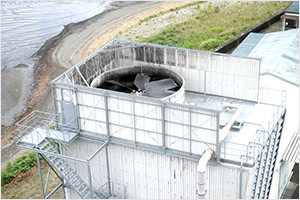
In 2019, the Shimizu Factory installed a cooling tower to cool hot water. This allowed the factory to circulate and reuse most of the cooling water used in its alcohol distillation facility. This move reduced the use of factory water by 9.1 million cubic meters between October 2019 and December 2024.
Contributing to the Development of Elemental Technologies for Bioprocesses That Reduce Environmental Impact as a “Zero Emissions Challenge Company”
The Ministry of Economy, Trade and Industry selected GODO SHUSEI as a “zero emissions challenge company(*),” defining it as a company embracing revolutionary innovations to realize a decarbonized society.
In the aims to contribute toward the development of new technologies that can reduce environmental impact in the fermentation industry, where Japan has traditionally excelled, and promoting fermentation-based “bio-manufacturing,” NEDO is running a project for the “development of production technology for bio-derived products that accelerates the realization of carbon recycling.” We are participating in the “research and development of a data-driven integrated bioproduction management system” for this project, and are engaging in the cultivation of filamentous bacteria for industrial protein production.
At the Enzymes and Pharmaceuticals Laboratory, the Company is working to reduce environmental impact in biomanufacturing using beneficial microorganisms by advancing industrial-scale validation of protein production processes. Using an improved strain of Aspergillus oryzae developed at Tohoku University, productivity has been empirically evaluated. Results showed a more than fivefold increase in the yield of target proteins compared to conventional strains, confirming the strain’s strong potential for industrial applications. Furthermore, the strain demonstrated superiority in terms of improving protein recovery rates from the culture medium from a production-level perspective, contributing to the development of more sustainable bioprocesses.
Currently, scale-up validation is ongoing at a pilot plant completed in March 2022, with a view toward full-scale production. Going forward, the Company will continue to collaborate with institutions such as Tohoku University and the National Institute of Advanced Industrial Science and Technology (AIST) to further improve strains and conduct ongoing validation of large-scale cultivation. Through these efforts, Oenon aims to enhance production efficiency, reduce environmental impact, and contribute to the establishment of a sustainable industrial foundation as a hub for biomanufacturing.
- * This refers to a company involved in one of four Ministry of Economy, Trade and Industry (METI) businesses and 28 New Energy and Industrial Technology Development Organization (NEDO) projects linked to the 39 themes of the METI “Environment Innovation Strategy.”
Working to Preserve the Environment through Our Products
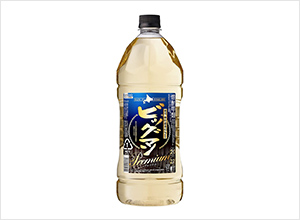
We donate a portion of our sales from Big Man Premium, a kou-type shochu, to the Hokkaido Environment Foundation. The donated funds help to protect Hokkaido’s natural environment.